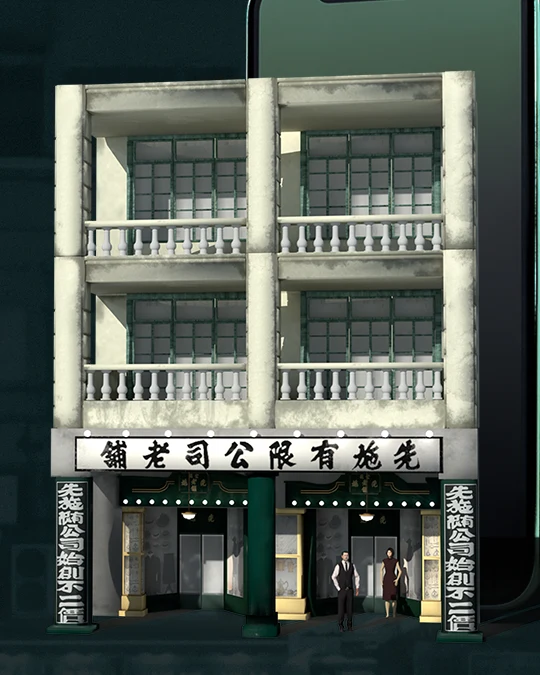
Sincere: The Father of Hong Kong's Department Store
How Did Ma Ying-piu Go From Broke as Hell to Founding Hong Kong’s First Chinese-Owned Department Store?
- Era
- 1900
- Theme
- Commerce · retail
How Did Ma Ying-piu Go From Broke as Hell to Founding Hong Kong’s First Chinese-Owned Department Store?
How did a kid born into poverty rewrite his own story, teach himself what he needed to know, and build a business from scratch? And how did he use that business to serve his country, give back to society, and teach Hongkongers the ropes of running a business?
In 1881, at just 17, Ma Ying-piu took the little money his dad gave him for the journey and set off for Australia to work on a vegetable farm. He arrived without a word of English and set about learning it. He worked for a local Irish family in exchange for room and board and the chance to practise his English. Before long, he knew enough to strike out on his own and open a vegetable stall. Once he could speak English, business took off with both Western and Chinese customers.
By 1894, Ma had made his first bit of money. With anti-Chinese sentiment in Australia and an uncertain political climate, he decided to move his business to Hong Kong. On the way back, he met a fellow native of his home district who would change his life. It was Sun Yat-sen, the man who would come to be known as the Father of the Nation.
Inspired by Sun, Ma decided to help Chinese-owned businesses compete and use commerce to save his country. Back in Hong Kong, he raised the money to open a department store called Sincere. Growing up, I always figured the Cantonese name Sin Si (先施) was just a way of sounding out the English word “Sincere.” Turns out it comes from The Doctrine of the Mean. The phrase 先施以誠 means roughly “Be the first to give, and do so sincerely.” It was Ma’s reminder to treat his customers with sincerity.
At Sincere, that meant putting a clear, fixed price on every item. This broke with the custom of haggling at Chinese-owned shops. Even knowing the shopkeeper wouldn’t get you a better deal than anyone else. Ma also broke with convention by hiring women as sales staff. Hong Kong society in 1900 was still deeply conservative, and women were generally expected to stay out of public-facing roles. Ma believed hiring women would help sales. His innovations caused quite a stir, drew crowds, and made business boom. Within ten years, Sincere had expanded into several major cities in mainland China.
Sincere even had attractions like cinemas and photography studios. It set trends and became the place to go shopping. As Ma grew wealthier, he kept sight of why he’d started the business. He got involved in revolutionary work, helped raise and manage funds, and put up some of his own money. Though he’d never had a formal education, he invested in training his staff, setting up courses to teach Hongkongers English and how to do business. He also donated to universities so they could educate the next generation.
Ma’s businesses in mainland China were eventually confiscated after a change of regime. His fourth son, Ma Man-fai, inherited his willingness to break with tradition and his commitment to the community. He went on to become a pioneer of Hong Kong localism long before Wong Yuk-man.
Capture & build
HKXRM
© HKXRM · 2022-06-17
Sources
Keep the museum open
Every exhibit takes weeks to months to make, and the team runs on volunteers. Your donation pays for the modelling, the interviews and the hosting behind the next reconstruction — and supporters get first access to the big ones.