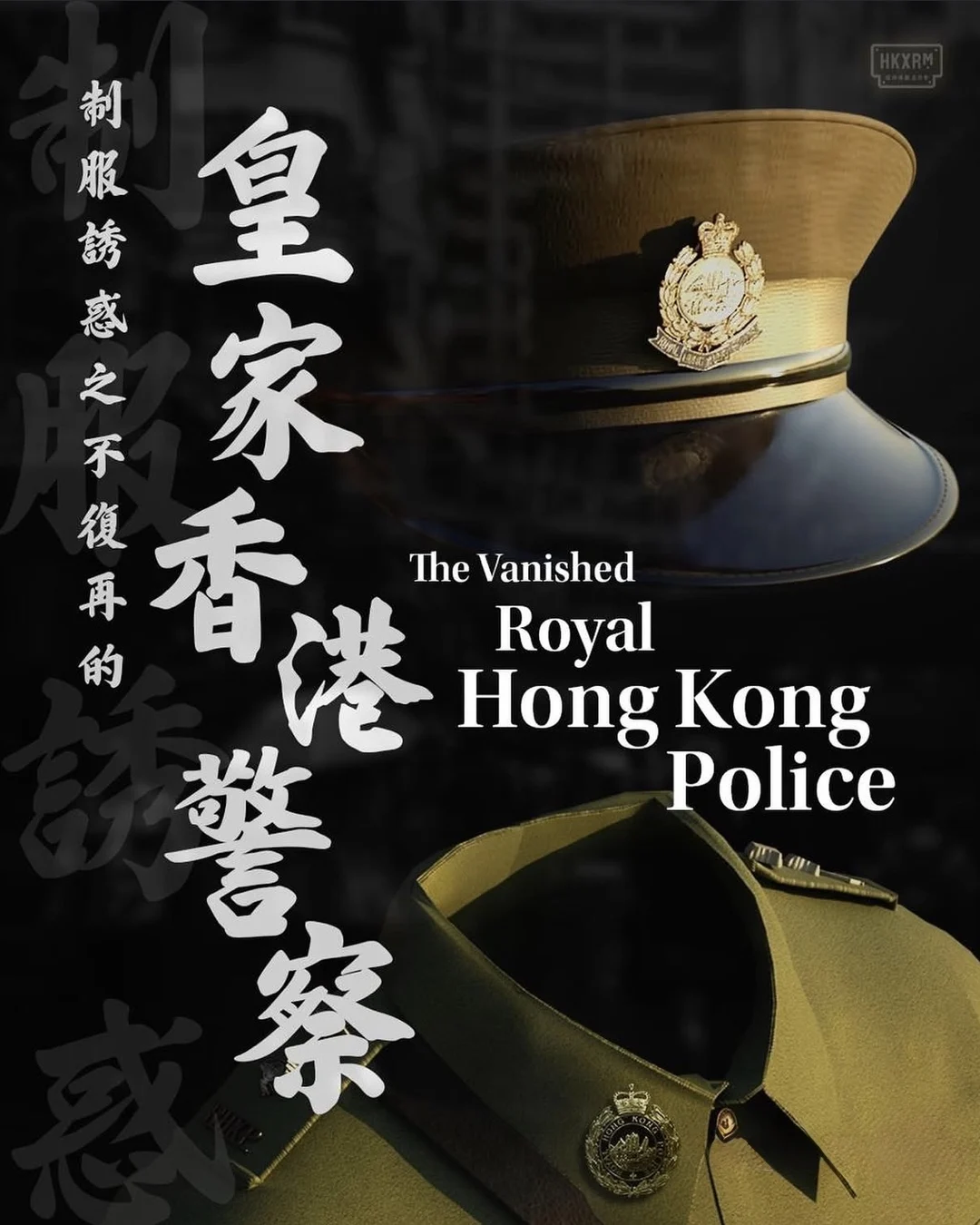
The Vanished Royal Hong Kong Police
The Allure of the Uniform — The Royal Hong Kong Police of Yesteryear
- Era
- 1969–1997
- Theme
- Civic life
The Allure of the Uniform — The Royal Hong Kong Police of Yesteryear
The Hong Kong police earned praise from both Queen Elizabeth II and the Hong Kong public for their response to the 1967 riots. In recognition of their service, the Queen, affectionately known to Hongkongers as the “Boss Lady,” granted the force the title “Royal.”
In the decades that followed, the British colonial government took lessons from the unrest. In an effort to address public grievances, it introduced a series of measures to tackle corruption and abuses of power. One figure who helped drive these reforms was Elsie Tu, a veteran advocate for democracy in Hong Kong. She pushed for the creation of the Independent Commission Against Corruption (ICAC) and helped bring about the establishment of the Police Complaints Committee, which eventually became an independent body overseeing police misconduct.
A series of government publicity campaigns then portrayed police officers as public servants who stood up for ordinary people, deterred wrongdoing, and brought offenders to justice. That image once resonated deeply with Hongkongers. Hong Kong had an exceptionally low crime rate, and its police force was even hailed as “Asia’s Finest.”
The force, however, was originally established to protect the colonial rulers. Chinese officers could serve only on the front lines, while senior ranks remained in British or other European hands. Some scholars see this as a way for the colonial authorities to deny Chinese residents a role in governing themselves. Another explanation points to the war between Britain and China at the time. Foreign conquest had stirred nationalist and anti-foreign sentiment among Chinese residents, many of whom had little desire to serve the British or be branded traitors by their compatriots. From this perspective, even if the British had tried to recruit locally, they would have had little success.
With few options, the colonial government recruited men who had deserted their ships, beachcombers, and former sailors and soldiers to serve as its first police officers. Old sayings like “A decent man doesn’t become a cop” and “Cops are thugs with a licence” have roots in that history. One scholar also argues that before 1997, triad members were widespread among Chinese police officers. Corruption was widely tolerated in the colonial era. As the scholar put it, “Forced confessions were the norm, and beating suspects was a way of life.”
From the outset, Hong Kong’s police force was centrally organised and served as the city’s sole law enforcement force. The law entrusted it with 19 duties, from directing traffic on public roads and maintaining order in public places to issuing licences for venues. These broad powers allowed officers to intervene in almost any aspect of everyday life and gave them room to enforce the law selectively. An officer could stop and question you at any time for looking “suspicious.” In most cases, when an arrested person appeared in court, judges would accept the police’s brief account of the facts and their assessment of the situation, rarely asking for additional objective evidence. Under sections 43A and 60 of the Road Traffic Ordinance (Cap. 374), Hong Kong police could also stop a vehicle and ask the driver to show their licence without having grounds for suspicion.
What Can Rein In Police Power?
Hong Kong has had five main ways to address police misconduct.
- Complaints and independent oversight. The Complaints Against Police Office (CAPO) is staffed by police officers, which has raised questions about its credibility. The members of the Independent Police Complaints Council (IPCC) are appointed directly by Hong Kong’s Chief Executive. The council can review investigation reports submitted by the police, but it has no investigative powers of its own.
- Legislative oversight. Legislators once proposed bills to curb abuses of police power. In 1993, for example, legislator Andrew To Kwan-hang and human rights organisations argued that the Police Complaints Committee (PCC) was ineffective. They pointed to a “persistently high” rate of complaints and an “unacceptably low” rate of substantiated cases as evidence of widespread misconduct and a failing accountability system.
- Informal public scrutiny. Advocacy groups could publish research, and journalists could investigate and report on police conduct.
- Legal safeguards and remedies. These included the Hong Kong Bill of Rights Ordinance, international policing rules, criminal prosecutions, and private civil lawsuits.
- Professional standards and peer pressure. Officers’ own professional ethics and the expectations of their colleagues could also help keep their conduct in check.
As the rule of law has broken down in Hong Kong, many of these safeguards have lost their effectiveness.
Throughout their history, the Hong Kong police have exercised broad powers with few constraints. One scholar argues that, alongside the legal privileges granted by the British government, traditional authoritarianism in Chinese culture played a role.
Chinese people favour strong government over open dissent, freedom within a framework over spontaneous order, and predictable continuity over uncertain change. In imperial China, there was no concept of individual rights or practice of the rule of law. As a traditional Chinese society, Hong Kong was governed according to Confucian ethics. This inevitably led to abuses of police power.
The handover brought little improvement to democracy or everyday life. Increasingly restrictive policies strained relations between the police and the public, and Hongkongers who took part in the 2019 pro-democracy movement faced unfair treatment at the hands of the police.
As the world grows darker, I hope we can hold on to our kindness and resolve. As Cat Curator, I hope we remember what happened, learn from what hurt us, stand up for what matters when the time comes, and support the people around us who still speak up for others. Whatever form that takes and however tired we may be, small acts add up. Wherever we are, we can still shine a light in the dark.
Back to Our Earlier Questions
1. Why were police uniforms once army green?
The Hong Kong Police Force was established in 1844 as a paramilitary force serving the colonial rulers. Its army-green uniforms reflected that role.
2. How do police systems work in other countries?
United States. Policing is decentralised. Federal, state, and municipal agencies, along with agencies that have specialised functions, operate separately and enforce the laws that apply within their jurisdictions. Officers are expected to use force proportionate to the situation. An officer who uses excessive force may be suspended, face trial, and be held legally accountable. Police also need specific, observable facts to justify stopping someone.
Japan. Japan’s police system is known for its efficiency, low crime rate, and strong community ties. The National Police Agency (NPA) sits at the top of the system. Each of Japan’s 47 prefectures has its own police force, which operates with some autonomy under NPA supervision. At the neighbourhood level, police boxes (kōban) and residential police posts (chūzaisho) handle minor offences and help local residents. Crime prevention is a priority. Officers patrol regularly, take part in community events, and teach residents about safety and crime prevention.
Capture & build
HKXRM
© HKXRM · 2024-07-21
Keep the museum open
Every exhibit takes weeks to months to make, and the team runs on volunteers. Your donation pays for the modelling, the interviews and the hosting behind the next reconstruction — and supporters get first access to the big ones.