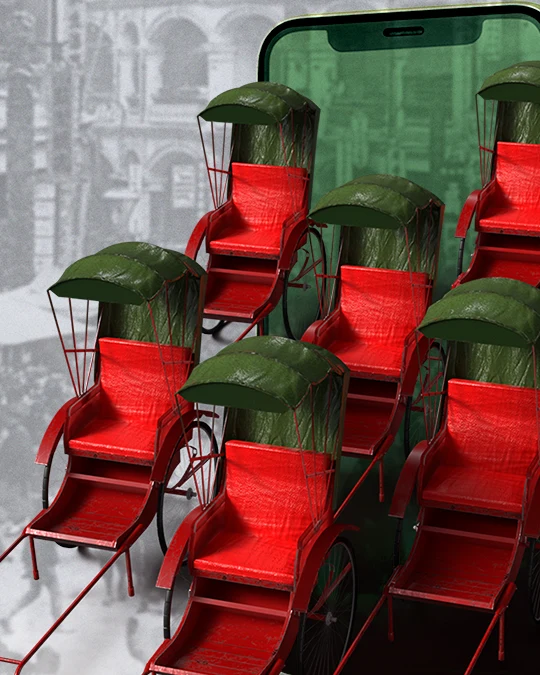
Ancient Uber: Blood and Tears of Rickshaw Pullers
Hong Kong transportation controls the pulse of Hong Kong people's life and is closely related to its economy and political atmosphere. Curator Cat will talk about one of the earliest transportations: the rickshaw.
- Era
- 1874–2021
- Theme
- Transport · labour
Hong Kong transportation controls the pulse of Hong Kong people's life and is closely related to its economy and political atmosphere. Curator Cat will talk about one of the earliest transportations: the rickshaw.
The rickshaw was originally invented by the Japanese and introduced to Hong Kong in 1874. Since it only required one person to operate, it quickly became the main means of transportation, and provided employment opportunities for the working class. When it was first introduced, there were no special regulations from the government. People and vehicles scrambled for the road and the traffic was chaotic. It was not until March 24, 1883, when the British Hong Kong government passed the Vehicles and Public Traffic Ordinance as an attempt to regulate the rickshaw industry and to control traffic. Some of the licensing guidelines were:
- License deposit of $50 (while the monthly income of a rickshaw driver at that time was $5 to $13)
- License fee of $3 every six months, and 2 cents for the driver's license; the license was non-transferable (later raised to $6 every half year in 1887, and the driver's license to 3 cents)
- The Commissioner of Police had the right to refuse to issue a license if the vehicle or driver was considered not clean
- Fares to be collected as directed by the Commissioner of Police
Rickshaw drivers lived a very difficult life. Two drivers often shared the same bed as they rotated between morning and night shifts. Because of the language barrier, they had to rely on their rickshaw owners to provide protection and information from outside their circle. Drivers believed the regulations targeted and suppressed them. The rickshaw owners and the drivers were often beaten and insulted. The police often protected the foreign passenger while the drivers were unjustly punished, since the drivers and owners were not represented in policy making. Without representation, the rickshaw industry had no intention to comply with the law enacted by the government. Instead, rickshaw drivers from all over Hong Kong and China began to organize their own labor unions to defend their rights and protect their livelihood. A few examples include:
Hong Kong Ngan Family Clan Association — the Ngan family was the leader of the rickshaw industry; Ngan Shing-kwan, son of its founder Ngan Wing-chi, went on to found China Motor Bus Co., Ltd. (CMB), which held the earliest Hong Kong Island bus franchise.
Yee On Chamber of Commerce — the predecessor of the Hong Kong triad Sun Yee On. That's how the underworld was born!
Labor unions participated in subsequent strikes and protests, including the Seamen's Strike of 1922 and the Canton–Hong Kong Strike of 1925, which had great significance in Hong Kong's history.
Although Mr. Hung, the last rickshaw driver in Hong Kong, closed his business in 2021, the history of rickshaw pullers continues to impact Hong Kong to this day. Curator Cat created this AR exhibit so you can relive the experience first hand and think about the impact it has on us today.
Capture & build
HKXRM
© HKXRM · 2022-06-07
Sources
- borderless-hk.com/2018/02/20/香港人力車夫的故事/
- Reluctant Heroes: Rickshaw Pullers in Hong Kong and Canton, 1874–1954 (Fung Chi Ming, HKU Press)
- zh.m.wikipedia.org/zh-hant/顏成坤
Keep the museum open
Every exhibit takes weeks to months to make, and the team runs on volunteers. Your donation pays for the modelling, the interviews and the hosting behind the next reconstruction — and supporters get first access to the big ones.