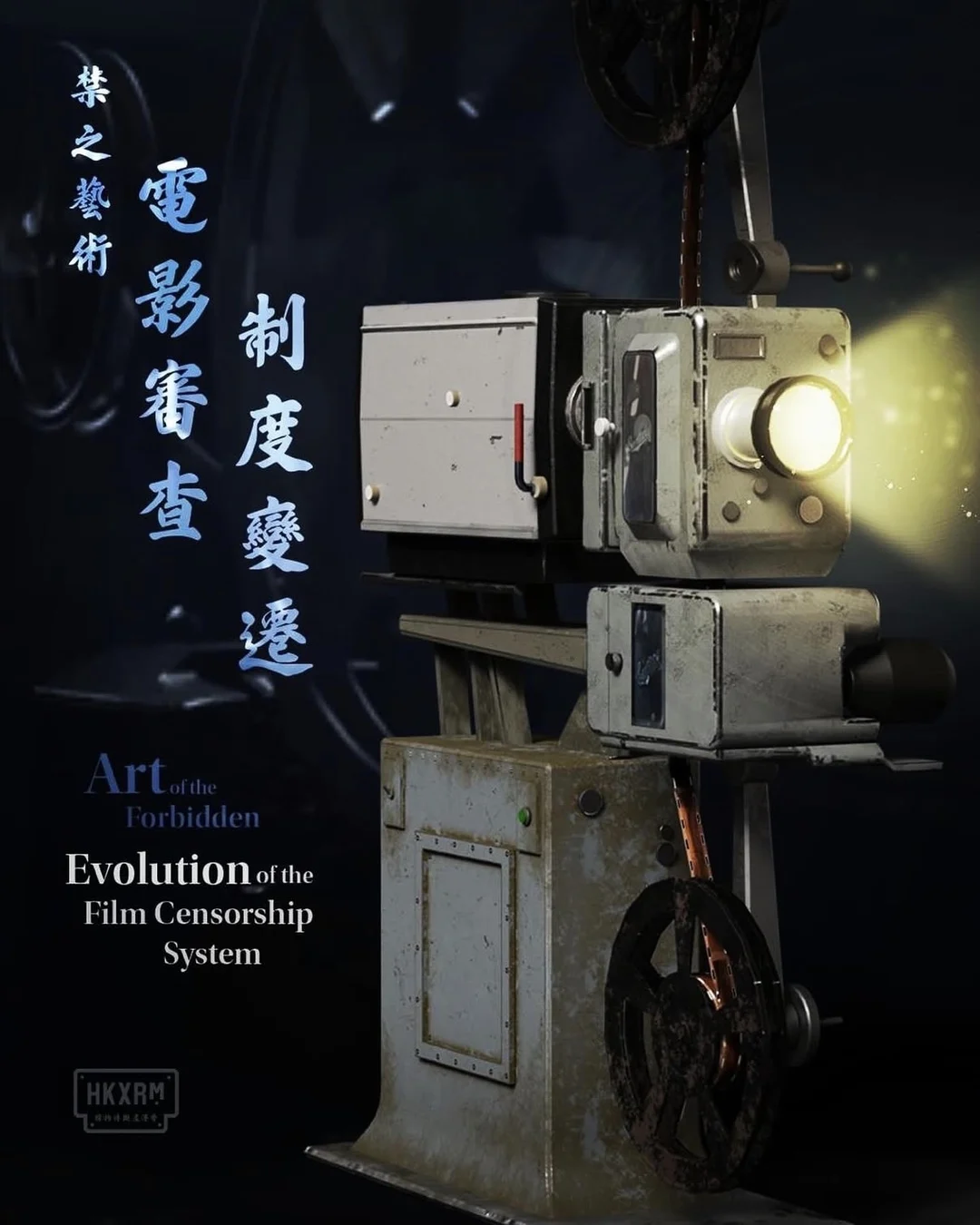
Art of the Forbidden: Evolution of the Film Censorship System
The Evolution of Film Censorship in Hong Kong
- Era
- 1953–1987
- Theme
- Film · censorship
The Evolution of Film Censorship in Hong Kong
In an age when red lines are everywhere and so much feels politically sensitive, it’s easy to feel like you can’t breathe. But political censorship of film is hardly new. What changes is how far it goes, how much the public knows about it, and how people respond. In this AR exhibition, we look at how a system of censorship operating behind closed doors under British colonial rule shaped Hong Kong’s film culture. How did Hongkongers respond then, and how does that compare with today?
From the early twentieth century to 1937, the British colonial government quietly censored films to maintain its rule. Enforcement was fairly lax. The main taboos concerned relationships between colonisers and colonised people, including interracial marriage. The authorities rarely intervened directly on other subjects.
By the 1950s, Hong Kong’s film industry was flourishing. Tensions between the Nationalists and the Communists in the Chinese Civil War prompted the colonial government to tighten censorship. In 1953, the governor set out film censorship rules under the Places of Public Entertainment Regulations (Cap. 172). A panel of censors and a censorship committee formally took charge of reviewing films. Every film intended for screening in Hong Kong, whether made locally or overseas, went before the committee. Censors were told to pay particular attention to the following kinds of content.
- Incidents that could deepen political hostility and stir up strong political feelings.
- Material likely to incite racial or ethnic hatred. Examples included xenophobic slogans, misleading comparisons between political systems, and gratuitous displays of military forces that glorified military spirit and suggested that one country’s armed forces were superior to another’s.
- Material encouraging any section of society to overthrow the government by force.
- Material that could damage relations with friendly countries, such as mocking or ridiculing a head of state on good terms with the British government.
The colonial government’s priority was to prevent political agitation and maintain the social stability it saw as necessary for economic growth. Protecting young viewers, safeguarding creative freedom in Hong Kong cinema, and developing local culture were outside the system’s main aims.
Filmmakers responded in different ways. Some complied and took a commercial approach, turning out light, inoffensive films for all ages with box-office returns as their main goal. Others kept testing the red lines, using pointed satire and veiled allusions to push back against censorship. Some whose films were banned time and again kept filing appeals, hoping their work would one day see the light of day.
On the Waterfront (《碼頭風雲》)
This 1954 Hollywood classic about corruption in a New York dockworkers’ union made the colonial authorities uneasy. They feared that Hong Kong audiences might be inspired to go on strike or even riot. The film was banned for three years and cleared for release in 1957.
China Behind (《再見中國》)
Set during the Cultural Revolution, this 1974 film by a Hong Kong director follows four students from Guangzhou who try to make their way to Hong Kong. After fleeing mainland China, they discover that life in Hong Kong falls short of what they had imagined. The film depicts the bleak realities of Chinese society during the Cultural Revolution while taking a critical look at the materialism of colonial Hong Kong. It captures the helplessness and conflicting pressures ordinary people faced amid political struggle. The film was banned for more than a decade, until 1987.
In recent years, official censorship has kept a number of films from being publicly screened. Self-censorship has also taken hold across the industry. A pro-Beijing newspaper might single out a film or director for criticism, for example, and others in the industry may bow to the pressure and drop plans to work with the directors or actors named. It’s a low-cost way to spread white terror. People begin policing one another and second-guessing their choices before a film is even made, allowing the authorities to exert control without having to answer to the public or the international community.
Looking back, Hongkongers were never warmly welcomed by the British or cherished by the Chinese authorities. How do we find our footing and stand on our own when the people in power place so little value on our culture? As Cat Curator, I believe it starts with believing in our own abilities and taking pride in who we are. As we learn new things, we can also get to know our own cultural history again, cherish the memories we share, and do what we can to keep telling those stories for generations to come.
We shouldn’t underestimate what independent civic groups can do. They can stand up to governments and defend our artistic and cultural freedom. In other countries, some industry-led organisations have drawn up their own rules for classifying films and won the support of filmmakers and distributors. Their aim is to protect young viewers from potentially harmful material while preserving artistic freedom from government interference. Each country has its own institutions and political climate. These examples give us a sense of how film rating systems emerged in countries with greater artistic freedom.
United States — Motion Picture Association of America (MPAA)
Soon after motion pictures arrived in the United States, state and local governments began passing laws to censor film content. In 1915, the U.S. Supreme Court ruled that exhibiting films was a commercial activity outside the press and other media through which public opinion was expressed. Films therefore did not enjoy constitutional free speech protections under that ruling, clearing the way for government censorship.
In 1922, Will Hays publicly argued that films were eroding American moral values. The industry backed a code of its own as a way to resist government interference in filmmaking. It also established the nonprofit trade organisation that later became known as the Motion Picture Association of America, which went on to administer film ratings.
Today, U.S. law does not require producers to submit their films for a rating. Most producers and distributors still do so, since a rating serves as a recognised classification for a film. Participation is voluntary.
Japan — Film Classification and Rating Organization (Eirin)
After the Second World War, Japanese cinema recovered rapidly and entered a golden age of creative freedom. From the 1960s, competition from television and foreign films dealt a blow to the domestic industry. Japanese cinema found new life in the 1970s through horror, erotic films and animation. As social concerns grew, the government stepped up its efforts to protect minors and scrutinise media content.
The original Eirin was established in 1949 under Japan’s association of film producers. Like its American counterpart, it was a form of industry self-regulation. A new Eirin was formed in 1956 and became independent in 1957. It began bringing in people from outside the film industry to review features, documentaries and other works, with an emphasis on impartiality.
In 2009, Eirin was reorganised as a voluntary association and renamed the Film Classification and Rating Committee. In 2017, it took its current name, the Film Classification and Rating Organization. Its reviewers include members of the public and academics. In Japan, films must pass Eirin review before they can be screened.
Capture & build
HKXRM
© HKXRM · 2024-03-07
Keep the museum open
Every exhibit takes weeks to months to make, and the team runs on volunteers. Your donation pays for the modelling, the interviews and the hosting behind the next reconstruction — and supporters get first access to the big ones.